
You have heard that Access to Work can help. Maybe a colleague mentioned it, or an assessor recommended it. But where do you actually start, and what does the letter mean when it finally arrives?
You are not alone in asking. Access to Work is one of the questions we hear most, and one of the hardest to find a straight answer on. The scheme is also under real pressure, with tens of thousands of applications waiting for a decision.
That makes preparation matter more than ever. This Access to Work guide walks you through what the scheme pays for, who can apply, how to get your application right first time, and what happens after an award. At the end, you will find our free Access to Work guides, written in plain English, to take with you.
What is Access to Work?
Access to Work is a government grant scheme run by the Department for Work and Pensions (DWP). It can help you get or stay in work if you have a disability or a physical or mental health condition, including neurodivergent people.
The grant does not affect other benefits you receive, and you do not have to pay it back.
What can Access to Work pay for?
The scheme can fund practical support that goes beyond what your employer already provides. According to GOV.UK, that can include:
- Specialist equipment and assistive software
- A support worker, such as a job coach or a British Sign Language interpreter
- Help with travel to work if you cannot use public transport
- Vehicle adaptations and physical changes to your workplace
- Mental health support
- Communication support at job interviews

For many neurodivergent people, the most useful element is coaching. We come back to that in the award section below.
How does it sit alongside reasonable adjustments?
Access to Work does not replace your employer’s legal duties. Under the Equality Act 2010, employers must make reasonable adjustments for disabled employees, and many neurodivergent people are covered.
Access to Work sits on top of those adjustments. It is designed for support that goes further than an employer could reasonably be expected to provide. Larger employers may also be asked to contribute towards some costs.
Why getting it right first time matters more now
Demand has grown fast. The National Audit Office found that 74,200 people received Access to Work support in 2024-25, nearly double the number six years earlier. Around half of them had mental health or learning conditions.
Processing has not kept pace. The average time to process an application rose from 28 days in 2020-21 to 66 days in 2024-25. In June 2026, the Public Accounts Committee reported around 66,000 applications waiting for a decision and called on DWP to clear the backlog urgently.
An incomplete application can add weeks to that wait. Preparation is the one part of the process you control.
Who can apply for Access to Work?
Access to Work eligibility is broader than many people expect. You apply yourself, not your employer, and the support is built around you and your job.
The four eligibility checks
You may be eligible if you:
- Are 16 or over
- Are in paid work, or starting or returning to work within the next 12 weeks
- Live and work in England, Scotland or Wales
- Have a disability or health condition that affects how you do your job
Employment, self-employment, apprenticeships, work trials, internships and placements can all count. Northern Ireland runs its own version of the scheme.
Do you need a formal diagnosis?
No. You do not need a formal diagnosis to apply for Access to Work. What matters is how your condition affects your work, and what would help.
This is important for neurodivergent adults who are still waiting for an assessment, which can take years. You can apply while you wait.
What if you are self-employed or starting a new job?
Self-employed people can apply, though you will need your Unique Taxpayer Reference (UTR) and the scheme will look at your business. If you are about to start a new role, you can apply up to 12 weeks before your start date, so support can be in place from day one.
How to apply: an Access to Work guide to the process
You can apply online through GOV.UK or by phone on 0800 121 7479, Monday to Friday, 9am to 5pm. If you use Relay UK, dial 18001 first. A British Sign Language video relay service is also available.
What to have ready before you start
Gathering this before you apply can save time later:
- Your contact details and your workplace address
- A clear description of how your condition affects your work
- A workplace contact, with their permission to be contacted
- Your National Insurance number
- Your UTR, if you are self-employed
The description is where many applications fall short. Be specific about the tasks you find harder and the situations that affect you, rather than listing a diagnosis alone.
What happens after you apply?
Access to Work reviews your application and may arrange an assessment of your needs. This is a conversation about your role, your working environment and what support would make a difference.
Recommendations from that conversation shape your award. If you have already had a workplace needs assessment, share what it recommended.
What should you do while you wait?
Keep a copy of everything you send and a note of any reference numbers. If your circumstances change, let Access to Work know.
Most importantly, do not put everything on hold. Your employer’s duty to make reasonable adjustments applies now, not only once a grant arrives.
What does my Access to Work award letter mean?
Your award letter lists the support you have been granted, often with hours and costs attached. The wording can be confusing, and it rarely explains what each item actually is.
Coaching by another name
Workplace Coping Strategy Training, Virtual Strategy Coaching Sessions, Workplace Strategy Mentoring Sessions and ADHD/Autism Coping Strategy Sessions all describe the same thing: coaching.
Neurodiversity coaching is a one-to-one conversation that helps you find strategies that work for the way you think. It builds on your strengths rather than prescribing fixed solutions. Many of the people we coach come to us through Access to Work, and all our coaches are trained to ILM Level 5.

Disability Impact Training and Disability Awareness Training
Some awards include one or both of these. Disability Impact Training is one-to-one input that builds your own understanding of your neurodivergence and how it shows up at work.
Disability Awareness Training is for the people around you. It is self-paced online learning for up to five colleagues who work most closely with you.
Co-coaching with your manager
Co-coaching brings you and your manager into sessions together with a qualified coach. It focuses on how you communicate and work together, and it is available alongside individual coaching.
Our award page explains what each type of support on your letter means, how booking works, and how invoicing and claims are handled.
What is in our free Access to Work guides?
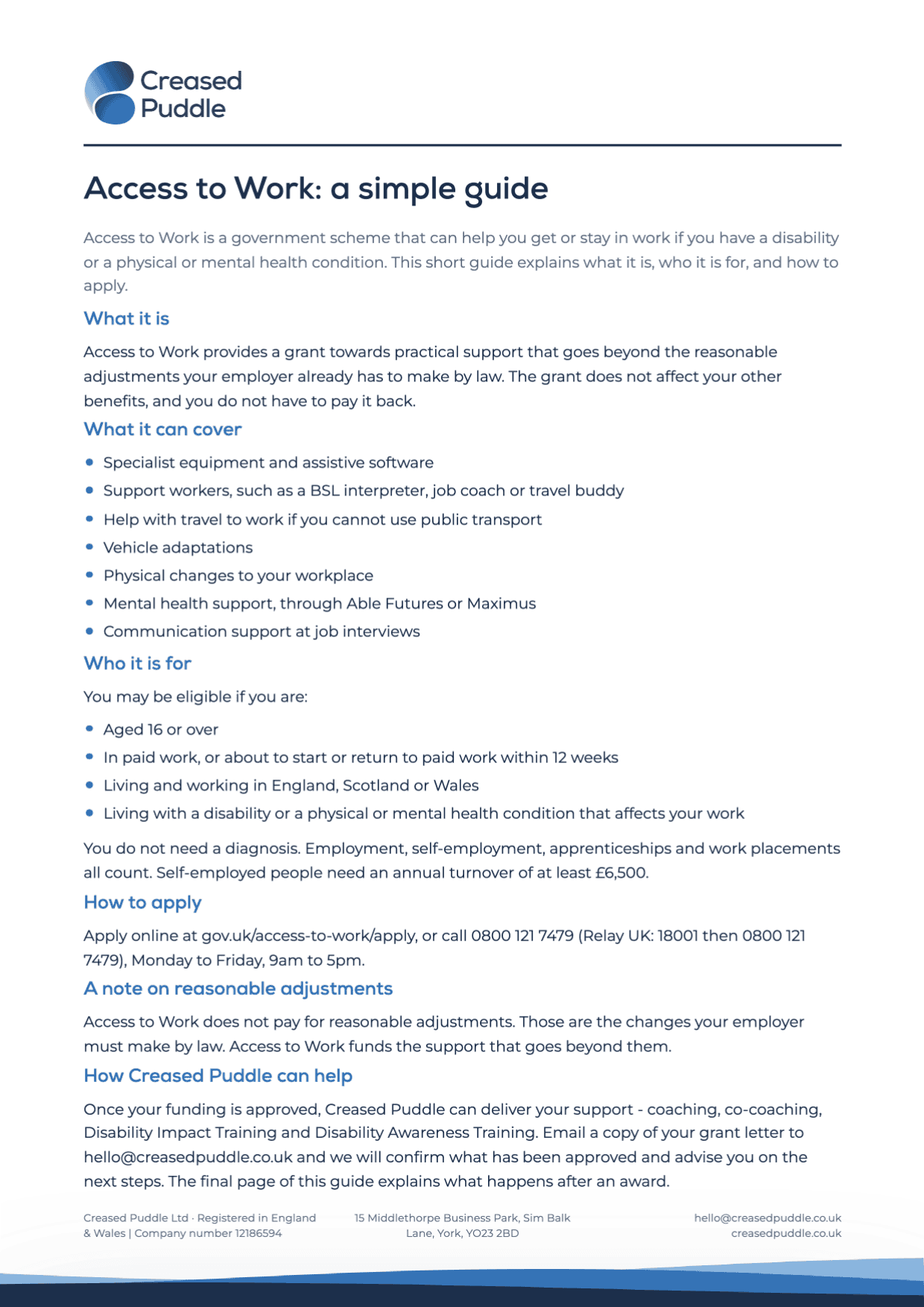
We have brought everything together in one free download. There are three guides, so you can use the one that matches where you are.
The guide
What Access to Work covers, who it is for, and how to apply. Start here if you are still working out whether the scheme applies to you.
The application checklist
Everything to have ready before you pick up the phone or open the online form. Use it to avoid gaps that could slow your application down.
After your award
What your letter means, and how booking and payment work. Keep it for when your award arrives.
You can download the free Access to Work guides from our main Access to Work page. They are written for neurodivergent employees and the managers supporting them.
What can employers and line managers do?
Access to Work is led by the individual, but managers make a real difference to how smoothly it goes.
Supporting an application
Agree to be the workplace contact if you are asked, and respond quickly when Access to Work gets in touch. Help your colleague describe the tasks and environment involved, and treat what they share as confidential.
If you are unsure how to respond to requests like this, our guide to managing reasonable adjustment requests fairly is a good place to start.
Do not wait for the award
With processing times as they are, an award can take months. In the meantime, the Equality Act still applies.
Small, low cost adjustments made now, such as flexible hours, quieter workspace or written instructions, can protect wellbeing and performance while the application is processed. When the award does arrive, invoices for coaching are typically paid by the employer and then reclaimed by the employee through Access to Work, so it helps to know that process in advance.
Your next step
Access to Work can fund meaningful support, but the process rewards preparation. Three things to take away:
- You do not need a formal diagnosis to apply, and you can apply up to 12 weeks before starting a job
- A clear, specific description of how your condition affects your work is the most important part of your application
- Reasonable adjustments do not have to wait for the award
If you have not applied yet, download our free Access to Work guides and use the checklist before you start. If your award letter has already arrived, send us a copy and we will talk you through what it means and how to book your support.