
Most organisations now have a neurodiversity or disability policy. It has been written, signed off, and published somewhere colleagues can find it. The harder question is what happens next. On a Tuesday morning, when an employee tells their manager they are struggling, does the policy shape that conversation?
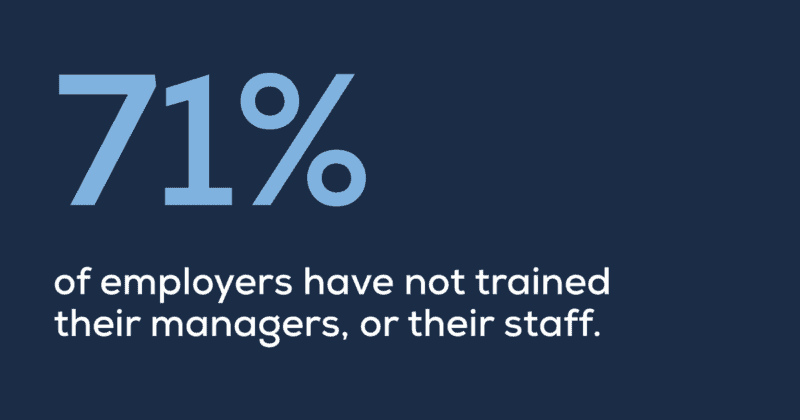
In September 2026, a poll of 398 HR, legal and compliance professionals found that 71% of employers had not trained their managers on disability discrimination, or their staff on neurodiversity. More than half, 57%, had provided no neurodiversity training to staff at all.
That distance, between a document that exists and a manager who knows how to use it, is the gap this post is about.
This post looks at what the evidence says about that gap, how it is showing up in employment tribunals, and what neurodiversity training for HR changes in practice. It closes with ten things you can put in place this month, most of them free.
What does the 71% figure tell us?
The headline number is striking, and the detail underneath it is more useful.
Half of those employers, 50%, had not trained managers on disability discrimination. 57% had given staff no neurodiversity training. And 35% had trained neither group at all. VinciWorks, who ran the poll, singled out that seven in ten figure as the one for HR and legal teams to look at.
A policy is not a practice
Writing the policy is usually the first step an organisation takes, and it is a real one. The policy exists, the intranet page is live, the commitment has been made publicly.
The step that tends to come later is showing the people who make day-to-day decisions how to apply it. That gap rarely surfaces during a policy review. It usually surfaces when an adjustment request reaches a manager who has not handled one before.
HR sits between the two
You are usually the team that sees all of it. The recruitment process that quietly screens people out, the adjustment request that stalled, the absence case that was really an unmet need, the performance conversation that went badly because nobody understood what they were looking at.
It is a demanding position, and it is also why HR is well placed to change how this works.
Why are neurodiversity tribunal claims rising?
The pattern is becoming visible in the tribunal data.
Analysis of HM Courts and Tribunals Service records by Irwin Mitchell found that employment tribunal cases involving neurodivergent conditions rose from 265 in 2020 to 517 in 2025, a 95% increase in five years. Autism accounted for 121 of those cases and ADHD for 118.
Missed obligations, not deliberate discrimination
The firm’s employment partner Jenny Arrowsmith made the important point: most of these cases do not come from employers setting out to discriminate. They come from employers not recognising their legal obligations early enough.
That points to a training gap rather than intent. It is also far easier to address at the first conversation than at the point of a claim.
When does neurodivergence count as a disability?
Under the Equality Act 2010, a person is disabled if a condition has a substantial and long-term adverse effect on their ability to carry out normal day-to-day activities. Many neurodivergent people meet that definition, which triggers your duty to make reasonable adjustments.
Two points follow that are easy to miss. First, Acas is clear that an employee does not have to tell you they are neurodivergent. Second, you should offer support whether or not someone has a diagnosis. Diagnostic waits in the UK are long, so support that depends on paperwork can be a long time arriving.
What does good neurodiversity training for HR actually change?
The change worth aiming for is capability rather than awareness. The research consistently separates the two.
The Neurodiversity in Business Research Report 2026, produced with Birkbeck, University of London, surveyed 605 people and found that psychological safety for neurodivergent employees has not improved since their 2023 research. Awareness has grown. Experience has not moved with it.
The CIPD makes the same point in its own guidance, summarised here by Wrigleys: neuroinclusion is not a tick box exercise or a one-off event. It is a long-term commitment to changing how the organisation works.
Disclosure improves when adjustments become ordinary
Acas guidance on building a neuroinclusive organisation notes that more than seven in ten employers, 72%, name employees not disclosing a need as a barrier to making adjustments.
That creates a loop. People are less likely to raise a need when they are unsure how it will be received, and the response is harder to improve when few requests come through. Training the people who receive those requests is one way to interrupt it.
What the evaluation evidence shows
This is measurable. In a 2026 programme we delivered to an NHS trust, with separate cohorts for HR, line managers and occupational health, participants’ understanding of reasonable adjustments rose from 6.1 to 9.0 on a ten point scale, and 96% rated their understanding at 8 or above afterwards.
Durability matters too. An independent University of Bath study of our custody training, covering 99 practitioners, found self-reported knowledge rose from 38.6% to 77.1% and confidence from 61.9% to 79.4%. Six months on, 92.86% said they had drawn on the training in subsequent interactions.
Different sector, same principle. Neurodiversity training for HR works the same way: focus it on the decisions people actually make, and the change holds long after the session ends.
10 practical ways to support neurodiversity in your HR team
None of these require a budget or a policy rewrite. Most can start this month.
- Normalise adjustments from the advert onwards. Say in the job advert that adjustments are available at every stage. It costs a sentence and it shifts who applies.
- Separate the adjustment from the diagnosis. Ask what someone needs to do the job well, not what they have been diagnosed with. You do not need a label to remove a barrier.
- Write a plain English route for requests. One page. Who to ask, what happens next, how long it takes. Most requests stall because nobody knows the path.
- Include the people who make the decisions. Voluntary awareness sessions tend to reach colleagues who are already interested. Make sure hiring managers and case handlers are in the room too.
- Record the adjustment, not the condition. Your record should say what was agreed and why it helps, so the arrangement survives a change of manager.
- Review adjustments on a date, not on a crisis. Put a review in the diary at three months. Our guidance on what to do when workplace adjustments are not working covers the conversation itself.
- Brief managers before absence and performance meetings. A ten minute conversation beforehand usually makes the meeting go better. See our approach to performance and absence management.
- Audit one recruitment stage for hidden barriers. Timed tests, unstructured interviews, and vague competency questions all screen out capable people. Pick one and fix it.
- Be consistent about what reasonable means. Two similar requests handled differently is a common source of grievances, and consistency is easier to explain later. Our guide on managing reasonable adjustment requests fairly sets out a workable standard.
- Decide when you refer, and to whom. Know the threshold at which a case needs a workplace needs assessment rather than a further internal conversation.
When should HR refer for a workplace needs assessment?
When the conversation has stopped producing new information, and you need to know what someone actually requires to do their job rather than what everyone assumes.
A workplace needs assessment looks at the person, the role and the environment together, then recommends specific adjustments. That is different from an occupational health report, which answers a fitness question, and different again from a GP letter, which is not written with your workplace in mind.
If your organisation refers often enough that the cost and the wait are becoming a problem, the answer is usually to bring the capability in-house. Our Level 4 Neurodiversity Workplace Needs Assessor course trains people to carry out those assessments themselves.
Where to start
Three things to take away. The gap in most organisations is not the policy, it is the training that would make the policy mean something. Rising tribunal numbers are mostly missed obligations rather than deliberate discrimination, which means they are preventable. And the evidence says training changes practice when it focuses on decisions rather than definitions.
If you want the grounding for your own team, our next session of neurodiversity training for HR runs on Thursday 5th November 2026, 10:00 to 13:00, live on Microsoft Teams. It is built for talent acquisition specialists, case managers and HR generalists, and it covers recruitment, onboarding, adjustment requests, absence and performance. There are 20 places so it stays a discussion, and it is £50 per person plus VAT.
Bring the cases you find hardest. That is what the session is for.